Saturday, May 12, 2012

A Handful of Sand

Anne here, talking today about another of our series #5 Aussie topic books, A Handful of Sand. It's about indigenous land rights — how the Gurindji people got their traditional land back.

As the back blurb says: It started as a struggle for pay and turned into a struggle for land rights. It took nine long years but finally the Gurindji got their land back. Read how they did it.

The book was written by Chris Malakar and, as always, illustrated by Moira Hanrahan. I have to say, I think Moira's drawings are getting better and better and this book contains some great examples.

Here's a drawing of the Gurindji stockmen mustering cattle. It was hard, dusty work and they got terrible pay for it.


The book is also one of our new pale green cover readers — it's longer than most of our books, but still has the same limited word count as the Green level 4 books — 300 unique words. (For an explanation of how we arrive at our levels, go here)

The Gurindji walk-off was a turning point in Australian indigenous history. If you want to read more about it, there's some information here.

There's a very moving you-tube here that gives you a brief look at some of the main events and some of the people involved.

There's a brilliant song here about it by Kev Carmody and Paul Kelly.

And if you'd like to hear the book read aloud, there's an audio file here.

You can also order the book.

Wednesday, April 18, 2012

ANZAC Day — Simpson and his Donkey

ANZAC day is coming up and you might want to read a story that's about the ANZACs — Simpson and his Donkey. It's a true story about Jack Simpson, a young man who joined the Australian army, hoping for a trip back to England to see his mother.

Instead he found himself landing in Turkey, at Gallipoli, under intense fire.

Jack Simpson wasn't exactly the perfect soldier — he didn't like taking orders, and he loved a good joke. Here he is posing with a skeleton for a photo. He often got into trouble.

He was a big, tall, strong fellow, so the army put him in the Ambulance Corps (corps means group of men.) His job was to work with a partner to carry wounded soldiers to the hospital tents.

But the fighting was on very steep ground and they were being shot at all the time, so it was hard to rescue the wounded soldiers. This is a real photo from 1915.

Simpson saw some donkeys running free and it gave him an idea. He caught a donkey and started carrying wounded soldiers to safety. Using the donkey he could rescue three times the men than he could  with a stretcher.
But this was against official orders.
He was very brave, and rescued many wounded soldiers in very dangerous situations.
The ordinary soldiers thought he was a hero.
His commanding officer agreed. He recommended Simpson for a medal.

But the top army brass didn't agree. 
They wouldn't give a medal to a man who was disobeying orders,  by using a donkey instead of carrying a stretcher.

Simpson became a legend.
He's on a gold coin, on stamps, and there are statues of him.
But Simpson never got his medal.

Wednesday, March 14, 2012

Series #5, an all Australian series

Anne here, writing to let you know that Series #5, our All Australian Series is now on sale. We had a number of problems and delays with the printing, but all that is behind us, now, and it's all OK.

There are 10 new titles, and we're hoping they'll be popular with Aussie readers in particular. For all you overseas readers, don't worry, Series #6 is in production as we speak and should be on sale in the first half of 2012.


In the next few weeks I'll talk about each of the books in turn, but in the meantime, here's a look at the covers. Both stories in level 1 (Yellow covers) are set in the desert, Australia's vast inland.  Running With Boats is about the famous Todd River Boat Race in Alice Springs, a race held on a dry river bed. It's a crazy event and people there have lot of fun.
 The Camel Man is about the Afghan and Indian cameleers who helped open up much of the outback, bringing goods and supplies to the isolated people living there.
Fire, one of our level two (red) books is about a danger many Australians are touched by every year — bushfire. Liz, Anne, Ian and Greg get caught up in a bushfire. It's based on a true story. This really happened to me and my friends.
On The Goldfields is a story from history, about life on the goldfields in the 1850's and gives a small insight into how it was for women.
Next, in level 3,  we have the story of Cyclone Tracy, which hit the city of Darwin on Christmas Eve.
And Moira has Would I Lie to You? — a tale of the Furphy tank, a water carrier that gave rise to a common expression "that's a furphy."
In level 4 we have the story of Australia's most beloved racehorse, Phar Lap. He died before most of us were born, but people still love Phar Lap. 
Finally we have three books at a new level. They're longer books, but we've kept the unique word count to the same as level 4, so they're longer to read, but not too hard, we hope. 
A Handful of Sand is about indigenous land rights -- it's the story of the Gurindji people, and how they fought to get their land back. 
Simpson and His Donkey is a beloved story from Word War One -- an ANZAC story, about Private  Jack Simpson and the donkeys he used to rescue wounded soldiers. In this book we use  a lot of historical photos from WW1, as well as some of Moira's cartoons.
 Lastly we have the story of Australia's best known bushranger, Ned Kelly. This book is entirely illustrated from historical photos and illustrations from Ned Kelly's own time, and are of interest in themselves.
 We're very proud of this new series. We hope you enjoy it.

Wednesday, September 28, 2011

At a conference

I went to the ACAL conference on Tuesday and Wednesday to display the new series of PageTurners. Series #5 isn't printed yet, but they will be soon. I made up some hand made versions of the books so people could read them and get an idea.
Series #5 is on topics that are particularly Australian — they're the sort of topics that come up year after year. There's NED KELLY, PHAR LAP, GOLD, FIRE, CYCLONE TRACY, and more.
These are the hand-made covers — the final books will look like the usual PageTurners.
And some more:

We're also introducing a new level — level 4 extended, with a light green cover. These have the same number of unique words as level 4 (300 unique words) but are longer and more complex. These titles are SIMPSON AND HIS DONKEY (an ANZAC story) A HANDFUL OF SAND (a story of indigenous land rights) and NED KELLY (outlaw or hero — you decide.)
It's always a pleasure going to conferences and displaying our books. So many people come up to say "We use these books all the time," or "My students love these books," and we talk about our classes, or maybe the PageTurners website and what's on it. 
Sometimes there are people standing nearby who've never seen the books, and when they hear other people saying nice things like this, they drift closer, and start looking through the books.  
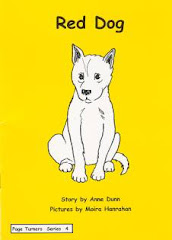
By the way, a lot of people said they'd been using RED DOG (from series 4) in conjunction with the movie that's out at the moment, but not many realized we had an interview on this blog with my friend, Janet, who actually had RED DOG hitch a ride with her.
This conference was at Victoria University, in the heart of Melbourne, on the 12th floor, so in the break I wandered out onto the terrace and took a few snaps. I'm still getting the hang of photos with an i-phone, so they're not great. But you get the idea. The photo below is looking south, across the Yarra River, away from the city. All the photos are away from the city.
This is looking to the west, down the Yarra, heading toward Port Phillip Bay.
And this is east, looking past the magnificent old Flinders St Station.
I'll post more information about the new series soon.

Wednesday, August 3, 2011

Red Dog, the Movie

Red Dog the movie is out today in Australia. 
It's a film about the very same Red Dog our book is based on.


I can't wait to see it.
It's not exactly the same as our book, of course. But it's about the same dog.
The dog who plays the part of Red Dog is called Koko. 


He's a really clever dog.
Here is a short clip of his screen test.
The director of the movie is talking to him.


Isn't he a cute dog?
They dyed his fur red for the movie.

 I love this poster, too.


I'm really looking forward to seeing this movie.
You can read more about it here.
You can buy our book about Red Dog here.
I wrote about Red Dog earlier on this blog. It contains a story from my friend Janet, who actually met the real Red Dog. You can read it here.


Sunday, December 5, 2010

Where do we get our ideas?

Anne here. People sometimes ask us where do we get our ideas for the stories.
The truth is, they come from everywhere — from other people, from seeing something or hearing a snatch of conversation. Sometimes they come from a story a student tells us, sometimes they come from our own lives and sometimes we just make them up.

The Dentist came from my own experience. For instance, at the time when we were thinking up stories for series #4, I needed to go to the dentist.

I'd put it off, because I'd cracked a tooth, and the nerve was dead, so I was fairly sure the dentist would want to pull it out. And I didn't want that.

When I was a kid the dentist had taken out four teeth to make room for the others. It was awful. It really hurt and I felt bad for days.

So I put my visit to the dentist off. And off.
It was easy to put it off because my dentist had died, and I didn't have a new one yet.
But I knew the tooth was going to be a problem. Decay happens.

Anyway, to cut a long story short, after series #4 came out I made an appointment with a new dentist.
And last week I had the tooth out.  To my amazement, it didn't hurt a bit. I wondered why I'd taken so long to go. All the waiting and worrying was worse than the tooth extraction.

So now you know where at least one of the stories comes from.
And maybe now the story needs changing.
You can listen to The Dentist story here.

Tuesday, September 21, 2010

PageTurners Levels

Anne here. Recently we were asked how we come up with the various levels for our books.


We've been teaching ESL and adult literacy for many years and seen various schemes for measuring readability wax and wane in popularity. Additionally, PageTurners are sold internationally and different countries do things differently.  

We didn't want to tie ourselves to any particular scheme, so when we were working out our levels we made it really simple — the number of unique words in a text, and the length of the text.

So...
Level 1 (yellow covers)
        — about 100 words long
        — up to 60 unique words

Level 2 (red covers)
        — about 200 words long
        — up to 150 unique words

Level 3 (blue covers)
        — around 300 words in total
        — about 200 unique words

Level 4 (green covers)
        — 400 - 600 words long
        — about 300 unique words

But it's a little more than that. Because we're experienced teachers we also go by instinct. We'll replace a difficult word with a simple one when we can. We hope the pictures will add to the ease of reading the text. We read the stories aloud and check that the sentences don't get too long or involved, especially at the lower levels. We usually trial them with adult learners as well.

First and foremost we want the books to be fun to read but we also want them to be useful and lead to good discussions.  We're always happy to consider suggestions and answer questions.